Filter by

Inorganic Constituents in Soil: Basics and Visuals
This open access book is a must-read for students of and beginners in soil science. In a well-organized and easy-to-follow manner, it provides basic outlines of soil minerals, new methods and recent developments in the field, with a special focus on visual aids. The chapters on primary minerals, secondary minerals, non-crystalline inorganic constituents and inorganic constituents sensitive t…
- الإصدارة
- -
- ردمك/ردمد
- 978-981-13-1213-7
- التوريق
- 181p.
- عنوان السلسلة
- -
- رقم الطلب
- 631-2/003
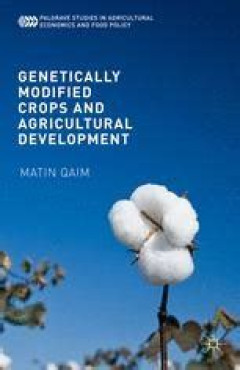
Genetically Modified crops and Agricultural Development
“This book is the second publication in the ‘Palgrave Studies in Agricultural Economics and Food Policy’ series, and targets both professional and lay audiences. … this book can be recommended to a wide readership; excellently written, it is one of the first books to address both the technical and policy dimensions of GMCs in development.” (George H. L. Rothschild, Food Security, Vol.…
- الإصدارة
- -
- ردمك/ردمد
- 978-1-349-95844-3
- التوريق
- 206p.
- عنوان السلسلة
- -
- رقم الطلب
- 631-2/002

Agronomy For development: the politics of knowledge in Agricultural research
Over the last decade there has been renewed interest in food security and the state of the global food system. Population growth, climate change and food price spikes have combined to focus new attention on the technologies and institutions that underpin the production and consumption of food that is varied, nutritious and safe. Knowledge politics within development-oriented agronomy set the…
- الإصدارة
- -
- ردمك/ردمد
- 978-1-138-24031-5
- التوريق
- 202p.
- عنوان السلسلة
- -
- رقم الطلب
- 631-2/001
Agricultural Biotechnology in Sub-Saharan Africa
This book offers a comprehensive analysis of the application level for various agricultural biotechnologies across Sub-Saharan Africa. The authors examine the capacity available as well as the enabling environment, including policy and investments, for facilitating agricultural biotechnology development and use in the region. For each Sub-Saharan country, the status of biotechnology application…
- الإصدارة
- -
- ردمك/ردمد
- 978-3-031-04351-2
- التوريق
- 197p.
- عنوان السلسلة
- -
- رقم الطلب
- 630-2/005
Precision Agriculture: Modelling
This book describes how models are used to monitor crops and soils in precision agriculture, and how they are used to support farmers’ decisions. The introductory section starts with an overview of precision agriculture from the early days of yield monitoring in the 1980s to the present, with a focus on the role of models. The section continues with descriptions of the different kinds of mode…
- الإصدارة
- -
- ردمك/ردمد
- 978-3031-15257-3
- التوريق
- 301p.
- عنوان السلسلة
- -
- رقم الطلب
- 630-2/004
Secondary Agriculture: Sustainability and livelihood in India
This book on ‘Secondary Agriculture’ discusses the goal of doubling farmers’ incomes. The term ‘secondary’ has a bearing on climate change adaptation and its mitigation, small farm viability and profitability, food security, nutrition, sustainable utilization of natural resources, and optimal usage of produce from primary agriculture and farm incomes. Promoting secondary agriculture h…
- الإصدارة
- -
- ردمك/ردمد
- 978-3-031-09217-6
- التوريق
- 211p.
- عنوان السلسلة
- -
- رقم الطلب
- 630-2/003

IoT and AI in Agriculture: self-sufficiency in food production to Achieve soc…
This book reviews recent innovations in the smart agriculture space that use the Internet of Things (IoT) and sensing to deliver Artificial Intelligence (AI) solutionsto agricultural productivity in the agricultural production hubs. In this regard, South and Southeast Asia are one of the major agricultural hubs of the world, facing challenges of climate change and feeding the fast-growing popul…
- الإصدارة
- -
- ردمك/ردمد
- 978-981-19-8115-9
- التوريق
- 461p.
- عنوان السلسلة
- -
- رقم الطلب
- 630-2/002
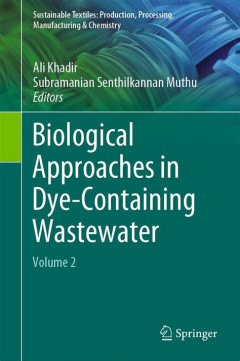
Biological Approaches in Dye-Containing Wastewater V2
This Volume 2 contains essential contributions highlighting the use of biotechnology in dye removal. It begins with an overview of activated sludge process for dye removal along with its limitation is carried out and describes the fundamental concepts of dye-containing textile wastewater treatments, particularly microbial and enzymatic approaches, including the most usual textile wastewater tre…
- الإصدارة
- -
- ردمك/ردمد
- 978-981-19-0525-4
- التوريق
- 233p.
- عنوان السلسلة
- -
- رقم الطلب
- 628-2/002
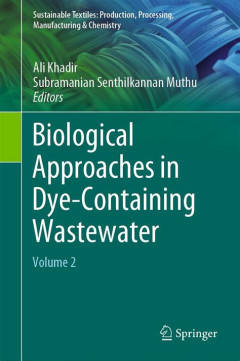
Biological Approaches in Dye-Containing Wastewater V1
The textile industry segment has been continuously expanding and it is reported that the global market was US$1000 billion in 2020. Aside from the fact that textile industry could be profitable and offers several advantages for human life, this industry produces wastewater containing many harmful substances in the form of organic and inorganic moieties. Textile wastewater can lead to serious en…
- الإصدارة
- -
- ردمك/ردمد
- 978-981-19-0544-5
- التوريق
- 286p.
- عنوان السلسلة
- -
- رقم الطلب
- 628-2/001
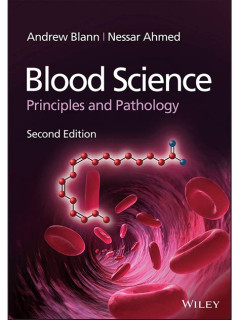
Blood Science: Principales and Pathology
Blood Science The second edition of the leading introduction to blood science, with updated new illustrations and case studies Blood Science: Principles and Pathology integrates hematology and blood transfusion, clinical biochemistry, and immunology to provide a thorough introduction to this rapidly expanding discipline. Reflecting recent changes in education and training for healthcare s…
- الإصدارة
- -
- ردمك/ردمد
- 978-1-119-86411-0
- التوريق
- 620p.
- عنوان السلسلة
- -
- رقم الطلب
- 616-2/001
 Computer Science, Information & General Works
 Philosophy & Psychology
 Religion
 Social Sciences
 اللغة
 Pure Science
 Applied Sciences
 Art & Recreation
 Literature
 History & Geography